
“What Does Change Look Like?” Clean Contracts and Prototypes

- Part 1: “Why Don’t They Change?” Because They Aren’t (Yet) Able To
- Part 2: “What Needs To Change?” How Value is the Key
- Part 3: “What Does Change Look Like?” Clean Contracts and Prototypes
The gap between today’s challenges and the ability to respond to them effectively continues to widen. Why? What’s going on? What’s needed to break out of this pattern? And how can we make the necessary changes understandable, natural, and achievable?
These aren’t new questions, and we’ve already written extensively about them throughout our site. But we do have a new way of presenting the answers, and that’s what we’ll be looking at in this series.
In this series, we’ve been looking at how our new quadrant model maps and explains what organizations need to change, what the challenges are, and what’s involved in addressing them:

We’ve also been holding in mind that this represents a deeper structure – where Q1 = Methods/How, Q1 =Results/What, Q3 = People/Who and Q4 = Purpose/Why – because it helps “ground” these quadrants even further.
In Part 1, we saw how the model maps and explains how where we are and where we need to be are diametrically opposed:
- Our center of gravity stubbornly remains in Q1, despite calls for change: defaulting back to fixed structures and traditional approaches
- But where we need our center of gravity to be is in Q4: responding to Complexity-driven uncertainty in agile and adaptive ways
Last time, we further explored the Q1 “trap” and how power is the underlying dynamic in all this.
We saw how the only form of power that organizations know how to exercise is “power-over”: tight control that either assumes a stable environment, or that aims to “tame” an unstable one.
But we also saw that this isn’t working and can’t work. Organizations need to let go of “power over” and embrace the shifts to:
- “Power in” our Complex environment
- “Power to” their people and partners to respond effectively to that environment
And we saw how Value is the only pattern breaker for starting this process – getting us past the Q1 “fault lines” that keep us trying to solve the challenges we face with the same tools that perpetuate and exacerbate those challenges.
So we set out a high-level conceptual vision of what it looks like to be led by Value: embracing, rather than resisting, the “power in” Complexity, and empowering and trusting in discernment at the front line, where that Value is to be realized.
But what does this actually look like in practice? And how do we get there with everything currently wired for Q1, and without incrementalism pulling us back?
These are the questions we’ll now answer by:
- Seeing what the end-point of change looks like – “power-in” and “power-to” fully in practice
- Explaining why we can’t jump straight there
- Mapping the only route forward that will actually work
Because Value as the pattern breaker is not just an idea; it’s something you can operationalize – starting with the safety of a prototype.
What full “power-in” and “power-to” look like
Let’s start with the end-point of change: what it looks like when the shift to “power-in” and “power-to” is complete.
Not because this is where organizations should begin – they shouldn’t – but because without seeing how radically different it is, everything that follows risks being misread as “just another improvement”.
And the clearest expression of the new paradigm – where “power-in” and “power-to” are fully embraced and harnessed – is what we call clean contracts.
Pretty much all organizations have contracts, and as our friends at WorldCC frequently – and correctly – say, “contracting is the least reformed business process”.
So, for these reasons alone, contracts are an obvious starting point to look at change: they’re immediately relevant, and change there is hard to miss.
But contracts are also the obvious starting point from within our quadrant model and how that model focuses our intention on Complexity, Value and power:
- Contracts regulate external relationships at the front line of Value: these relationships are (or ought to be) established entirely with the goal of serving and contributing to end-customer Value.
- Contracts are where organizations already believe Value is defined and how to realize that Value: authority, accountability, and Value are being defined.
- Complexity is most obvious in external relationships: another party is involved, with their own incentives, constraints, and agency; uncertainty, interdependence, and change are therefore no longer abstract.
- Contracts are currently the most concentrated expression of “power-over”: they are where organizations most explicitly attempt to neutralize Complexity through certainty, control, and risk transfer (you may remember last time that injunction from an “expert” to design for “70–80% certainty” and insert “mechanisms” to deal with the rest).
In other words, where contracts are now is trying to reach out from the current Q1 center of gravity and into the current Q3 operating reality:

So contracts are the litmus test… the canary in the mine… the first buds of spring… [insert metaphor here]…
They’re what will show if change has happened and is truly embedded. Or if it hasn’t, and it isn’t.
Because clean contracts are radical.
They’re not relational contracts, trust statements, behavioral charters, governance overlays, or a softer tone applied to the same old documents.
All of those can be — and routinely are — grafted onto Q1.
No, clean contracts are fundamentally different in their core substance:
- Explicit Value Codes that reflect the Things That Matter (more on both of these shortly)
- Clearly defined current and desired states (what “good” and “better” look like), which allow for change at pace
- Support for progressive evaluation rather than pass/fail compliance
- Generative of new insights, rather than consulted for predetermined stipulations
- Clear accountability for outcomes; not for activity
Clean contracts obviously retain the familiar legal, regulatory and commercial necessities – legal definitions, payment terms, confidentiality provisions, force majeure, and so on. Nobody is suggesting these things don’t matter, or that the contract is just an evaluation tool.
But what changes is what those necessities are in service of, and that’s the full and conscious transfer of power, authority and responsibility through making all Value explicit, communicable and continuously measurable.
Here are some extracts from a sample clean contract, and note the more familiar “relational contract” terminology, the way that objectives are clearly set out and familiar legal coverage remains assured, whilst the main focus becomes Value Codes:


Instead of being instruments of risk transfer and behavioral control, clean contracts are instruments for delegating authority and responsibility for discernment – for guided autonomy and for Value realization.
In deep structural terms, this is Q4 in action: contracts explicitly serving “Purpose” and “Why”, rather than focused on “Methods” and attempting to control “How”.
Once everyone can see what matters and what good looks like, and where accountability truly lies – both in terms of recourse and reward – the need to prescribe methods and behavior collapses.
Contract management switches from policing actions to stewarding outcomes – optimizing the opportunities for scaling into repeatable Q2 results that “reward” the hard work in Q3 and Q4.
“Power-over” has become “power-to” – power given to people and partners – to leverage the “power-in” of Value-harnessed Complexity.
And that means that clean contracts are the external expression of what we call Value Management:
- Management by Value, as the guiding principle
- Management of Value, through constant and unwavering focus on what matters most
- Management for Value, as the only goal for end customers and stakeholders
And all this happens under the auspices of a group – formal or informal, named or unnamed, and drawn from across the organization – that we call the “Value Management Function.”
This is why clean contracts are so revealing.
They make tangible this fundamentally different way of working- not just a better version of the old one, but a complete reimagination of contracts, contracting and the way organizations operate.
Why nobody can jump straight here
Now for the uncomfortable truth: almost nobody can start here.
Not because clean contracts are unrealistic; not because they’re naïve; not because they can’t satisfy legal or procurement requirement.
But because clean contracts represent too big a shift; because most organizations don’t yet have the frame of reference to recognize them as achievable and safe; because they sit at the far end of the Value-led journey we described last time (from “power-over”, through “power-in” in Q3 to “power-to” in Q4):

They represent the culmination of both moves – think of how a climber only moves one hold at a time – and they represent a full “escape” from the overwhelmingly dominant mindset, skillset and toolset of Q1.
In organizations still operating entirely within Q1 logic, clean contracts will almost inevitably be interpreted as any combination of:
- Vague and abstract
- Risky and imprecise
- Under-specified and open-ended
- Irresponsible and idealistic
Not because they are those things, but because the Q1-centered organization will compare them to their existing contracts and find them completely alien – because they’re still trying to read them through their “power-over” lens.
The constraints are real: existing legal frameworks, procurement rules and policies, risk governance expectations, organizational “muscle memory”, and the Q1 “immune system”.
Moreover, as we saw last time, Q1 ways of working have, over time, systematically displaced human judgement and discernment – a trend that is only accelerating with the way AI is typically being used.
Decision-making has been progressively embedded into rules, processes, standards and systems, so that “knowing what to do” is no longer exercised by people, but assumed to reside elsewhere – most recently, increasingly “outsourced” to AI.
The result is not just structural rigidity, but atrophy: people become less practised at interpreting context, weighing trade-offs, or judging what matters most in a given situation.
And this erosion of discernment is another reason why clean contracts feel risky or unrealistic.
So, overall, trying to “start with clean contracts” in this Q1-dominated environment will almost certainly fail – not because the destination is wrong (it isn’t), but because the organization has not yet crossed the thresholds that start to make that destination intelligible, let alone sustainable.
Acknowledging these constraints is crucial, because it allows us to be honest without losing ambition.
Yes, for all the reasons we’ve seen so far in this series, clean contracts are where you need to end up, but no – you can’t start here.
Breaking the apparent contradiction
At this point, it might feel like we’re stuck in a contradiction: we can’t jump straight to Q4, and incremental change doesn’t work, so what’s left?
The answer lies in a distinction that is easy to miss: incremental in scope is not the same as incremental in logic.
Incremental change to date has failed not simply because authority remains untouched, but because it stays entirely within Q1 “power-over” logic.
It doesn’t recognize the need for a pattern breaker, and it therefore can’t introduce one.
So it adds new contracting templates and clause libraries, new best practice, new training, and – increasingly – new technology, whilst leaving untouched the underlying assumptions about control, certainty, and prescription.
It’s that “dangerous mimicry” we talked about last time, which promises much, but which Q1 effortlessly absorbs and neutralizes through any combination of:
- The “doubling-down” response.
- Taking things from outside Q1 and grafting them on to existing approaches, neutralizing their ability to effect change (you may remember “VINO”).
What resolves the apparent contradiction is a small move with non-absorbable logic.
A move that looks modest on the surface – even “incremental”, for lack of a better term – and that doesn’t trigger either the Q1 immune system or cynicism about “transformation” (after so many broken “transformation” promises from consultants and technology vendors).
A move that quietly and irreversibly shifts from Q1 to Q3 – towards Value and “power-in” – to change the underlying operating conditions in a way that demonstrates its viability, repeatability and scalability.
And it involves a prototype of a new operating model: a prototype that meets people where they are, but that doesn’t leave them there; a prototype that gives them what they say they want, but also gives them what they actually need.
The bridge: a diagnostic-led prototype
The word “prototype” itself acknowledges that it’s something new, that it’s being “tested”, and that it’s bounded to a particular context; not a sweeping change.
This lowers perceived risk, reduces immune responses, and sets the frame as looking for insight and evidence; not assuming a conclusion or proving a point.
A prototype doesn’t require enterprise-wide permission, and it can run alongside existing structures.
And this second point is crucial, because the prototype can – and should – be presented as entirely consistent with Q1, i.e.:
- Focused on the operating model (a Q1 preoccupation).
- Evaluating if effective foundations are in place (a Q1 fundamental).
- Uncovering areas of strength and weakness (a Q1 priority).
- Generating data that AI can use to deepen understanding (Q1 “infrastructure”).
But the shifts towards Value and “power-in” are real, because alongside all this, the prototype will quietly shift the lens from “Methods” and “How” (Q1) to “People” and “Who” (Q3):
- Look through the lens of external relationships – potentially even engaging external partners in the process – which immediately, as we saw above, exposes us to Complexity
- Go beyond the traditional scope of Q1 – processes, systems, etc – and look at areas that are softer and more subjective, but crucial in understanding and being able to articulate (and focus on) Value
- Switch the nature and direction of evaluation from being occasional and retrospective to being continuous and forward-looking
- Engage people and partners (potentially at scale) and surface their potential to reveal expertise, discernment, passion and responsibility, paving the way for greater autonomy and self-organization
- Road test the greater transfer of authority and accountability
At its core, the prototype operates through one or more Diagnostics that make the Things That Matter evaluable through Value Codes.
Now, both of these have been written about extensively on our site – they’re at the heart of Value Management – but allow me a brief summary here.
Because, as we saw last time, Value is a much mis-understood word.
It gets dragged down into Q1 and grafted onto it as VINO – Value In Name Only – and so, to sidestep VINO, we instead talk in terms of Things That Matter – a “proxy” for Value, without having to “name” it.
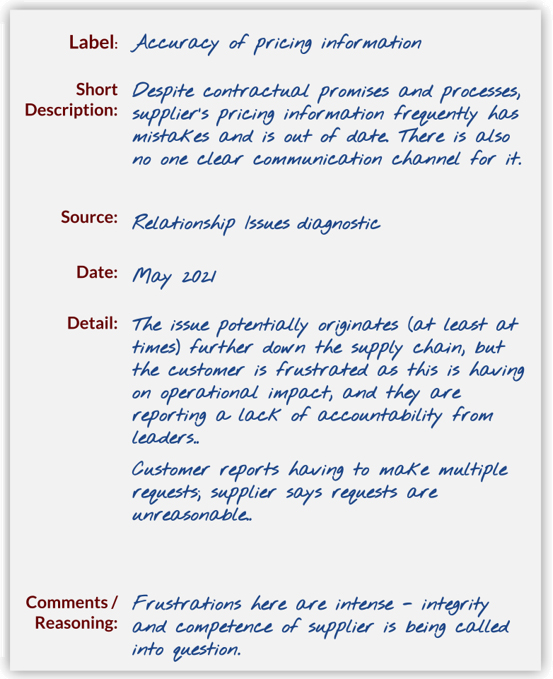
Everyone can immediately relate to the “Things That Matter” – the goals, outcomes, issues, risks or requirements that characterize any specific context – and they make the otherwise “abstract” or misunderstood concept of “Value” immediately grounded and relevant.
Every Diagnostic we offer encapsulates a set of the key Things That Matter to a particular relational priority: risk, strategy, negotiation, governance, etc.
And whilst, in the future, the responsibility for surfacing, articulating and continuously refining that set shifts to the customer (more particularly the Value Management Function we mentioned above), every “pre-canned” Diagnostic therefore forms a more-than-good-enough starting point for this new Value-led focus.
Each Diagnostic firstly encapsulates Q1 priorities – so it’s “safe”, and because there’s of course Value in Q1, too; we would never suggest otherwise (the issue is when Q1 becomes all that matters).
But each Diagnostic also widens the focus into what matters in Q3 and pushing towards Q4 – that concept I mentioned of meeting people where they are, but not leaving them there; of giving them not just what they want, but also what they need.
What then makes the Things That Matter evaluable are Value Codes – progressive statements towards what good looks like that simultaneously enable establishing the current state and looking ahead to what needs to change, and how:

We saw earlier how Value Codes are the core of clean contracts, and – with the lens being set to external relationships – Value they can therefore be evaluated with relationship partners, too: again, we’re nudging beyond Q1.
And evaluation is an ongoing and frequent process in Value Management prototypes; it’s not a one-off exercise to serve a management report or compare against a benchmark (although it can also do both of those things), but rather a source of forward-looking insight and a rapid test of effectiveness – including for course correction when needed.
Because Value Codes can’t help but be generative:
- They’re entirely focused on what matters, and only what matters.
- They actively invite participants to consider the tension between current state and desired state and what needs to happen to close the gap.
- Evaluations and comments given therefore become a rich source of patterns and ideas for improvement.
(Remember how, last time, we saw how Value is the way to harness the innovative potential inherent to Complexity?)
AI support then plays a critical – but subordinate – role:
- Identifying patterns across evaluations
- Consolidating insights across groups (and even relationships)
- Surfacing weak signals and emerging tensions
- Amplifying (not replacing) the human judgement that already exists and that is stimulated by the diagnostic process itself
In other words, AI supports sense-making, not control; it’s the servant and not the master – again, we’ve reversed Q1’s polarity.
This ordering matters. Introduced with a Q1 approach, AI does not augment judgement; it quietly replaces it.
Pattern recognition becomes proxy decision-making, fluency is mistaken for insight, and confidence shifts from human interpretation to machine-generated output.
Far from enabling adaptation, AI in this context accelerates the erosion of discernment that Q1 has already set in motion.
Even when not explicitly stating it as such (to avoid the Q1 immune response), a core purpose of the prototype is therefore to deliberately rebuild the human capability to judge – to practise discernment in live, consequential contexts, and re-establish human primacy over AI.
This primacy of people is one of the key ways the prototype starts to prepare the way for the move to Q4 – the “power-to” move – because it starts to engage and motivate them, with all their unique insights and scope for problem-solving and creativity.
Without fuss or fanfare, this shift to focus on patterns of movement and change couldn’t be more different from the familiar Q1-style survey or compliance check – creating a living signal of Value, rather than a static definition of what someone else says Value is (or was, given the usual retrospective focus).
And the other key way the prototype starts to prepare the way for Q4 is in the delivery option it has for network self-discovery.
So, whilst the initial focus may be a particular relationship or set of relationships, each partner engaged can, in turn, open up the process to its own relationships – the most obvious example is a supply chain, with its tiers, but there are others.
Again, whilst this encompasses the familiar – the idea of engaging a partner or partners – it also changes the logic from one of top-down Q1 “compliance” to bottom-up Q4 engagement.
How the prototype quietly changes the destination
So, although typically modest in scope, the prototype immediately creates a new platform:
- People who were previously disengaged become newly involved or reinvigorated
- Expertise and passion are revealed where it was previously invisible
- Conversations shift from defending positions to exploring meaning and direction
And, because it’s in a contained context, this means it’s safe for authority to begin to move – quietly – toward those closest to the issues and priorities that emerge: people can be given new latitude to take responsibility for particular outcomes and run with new ideas for achieving them.
And this new platform – this embryonic Value Management Function – is naturally self-extending. It can:
- Be repeated with a wider group
- Deepen the existing group by adding new diagnostics
- Or extend outward into adjacent relationships
Value propagates along the network; not by mandate, but by relevance.
And this is how a Value Management Function begins to form: not through central design, but through shared attention to what matters.
Yes, it all looks incremental from the outside.
People believe they are piloting something, testing an approach, and running a controlled experiment.
But internally, something profound and irreversible has happened. Power has moved:
- First, power-in has been explored – people beginning to learn to work with the forces of a Complex external environment through Value-led focus.
- Second, power-to has started to follow – people increasingly trusted and enabled to act with judgement, agency, and responsibility.
We’re not yet at clean contracts, and there’s a lot of work still to do, but you can hopefully see how we’re therefore now on the path toward them.
Value is being made explicit, desired states are already being articulated, evaluation is already replacing policing, and authority for outcomes is already shifting.
This is why the prototype work: it doesn’t outwardly argue for a new paradigm; it allows people to operate inside it, safely, before it ever needs to be named. It doesn’t create clean contracts, but it creates the conditions in which clean contracts stop looking risky and start looking obvious and inevitable.
And once that has happened, the organisation has crossed a line it cannot fully step back over.
Contracts can become about formalizing what already works: what matters, what good looks like, how progress is evaluated, and who is accountable for outcomes.
The organization will no longer be asking contracts to manage uncertainty, trust, or behaviour.
Those will already be being handled upstream through Value Management.
In conclusion
Three things matter in answering “how do you change?”.
First: you don’t start with the end state. Trying to impose a Q4 “artefact” like a clean contract onto a Q1 organization will fail.
Second: you switch incrementalism in approach to incrementalism in logic, making Value the new lens through which “power-over” can switch to “power-in”, and then “power-to”. If “power-over” logic remains intact, nothing important changes.
Third: you don’t educate or argue people out of Q1. You instead work with Q1 approaches, focus and language as far as you can whilst also changing the conditions under which Q1 no longer holds.
And at this point we can finish by again answering the question that opened this series: “Why don’t they change?”
But the answer is no longer “because they can’t (yet)”, but rather “because they refuse to see that it’s truly possible”.
When there was no identified and viable pattern breaker, organizations could perhaps be forgiven for remaining stuck in Q1.
Now, though, it’s a conscious choice: which choice will you make?

